The Oswego Formation: A Proven Horizontal Opportunity
The Oswego formation has produced in Oklahoma for over a century. Across the Kingfisher trend, 306 horizontal wells have generated $2.7 billion in oil and gas production (as of February 2026). A conventional limestone reservoir that rewrites the economics of horizontal drilling.
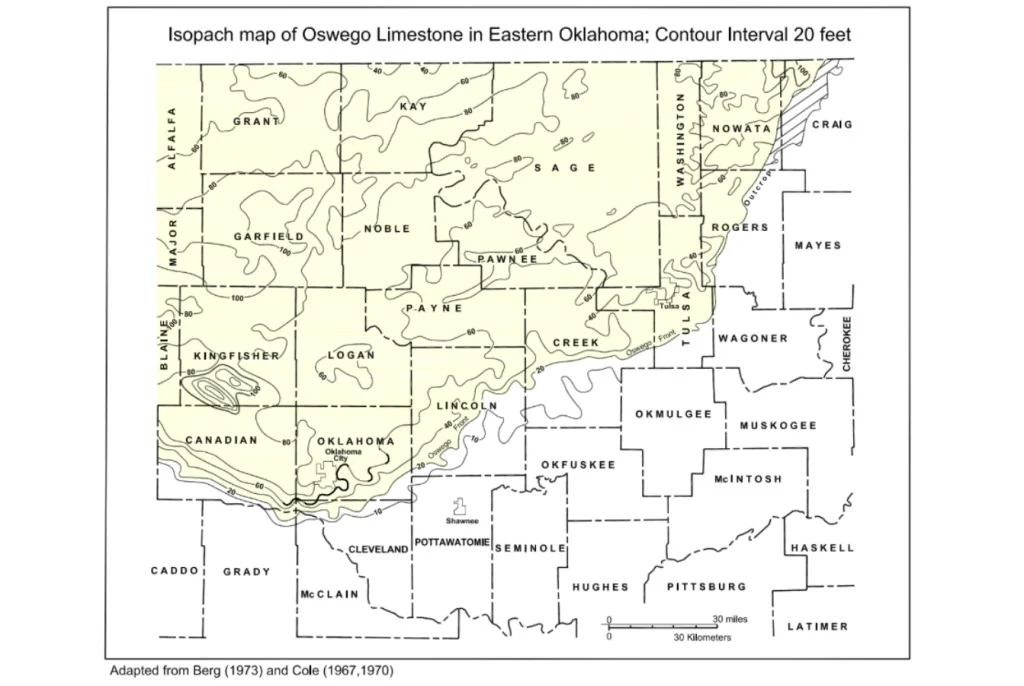
Click to enlarge
Oklahoma's Most Productive Conventional Reservoir
The Oswego Formation is a conventional limestone reservoir spanning nearly two-thirds of Oklahoma, from the northwest to the southeast. It is one of the state's most historically significant and productive oil-bearing formations, with continuous production documented for over a century.
306 producing horizontal wells in the Oswego formation across the Kingfisher County trend have generated $2.7 billion in oil and gas production (as of February 2026). The top-performing well, the Dover, has delivered 708,786 barrels over more than 11 years and is still producing. These are not projections. Every number is verifiable through the Oklahoma Corporation Commission.
This production data is analog and benchmark data from producing wells in the Oswego formation operated by other companies across the Kingfisher County trend. It is not production from Trilateral's own wells and is not a forecast. Past production does not guarantee future results.
The Wheeler No. 1
Drilled in March 1912 in Creek County, Oklahoma, to a depth of 2,400 feet. Initial production: 400 barrels per day. The well discovered the Cushing Anticline, one of America's most productive oil fields of the early 20th century.
The Wheeler No. 1 still produces today, 114 years later.
This is what the Oswego Formation delivers. Not rapid decline curves that collapse after 2–3 years like shale. Consistent, sustained production measured in decades, not quarters.
Why Is There Still Oil Left?
If the Oswego has been producing for over 100 years, the first question every investor asks is: what's left to get?
The answer lies in how it was drilled. Thousands of vertical wells were drilled on 10-to-40-acre spacing across the formation, with individual wells yielding over 100,000 barrels of oil along with additional gas reserves. Despite its often underestimated low porosity (typically 6% to 8%), the Oswego proved to be prolific wherever vertical wells intersected its natural fractures.
But vertical wells only access what they happen to hit. The Oswego's oil is stored in compartmentalized pockets created by natural vertical fractures. A vertical well might intersect one or two of these fractures by chance. The rest of the oil, trapped in thousands of adjacent compartments across the same section, remains completely untouched.
Traditional vertical drilling recovered only a fraction of the total oil in place. The reserves between those wells have been sitting there, under pressure, waiting for a technology that could reach them horizontally.
The Science Behind the Opportunity
The Oswego's limestone is brittle. Over millions of years of tectonic activity, this brittleness has created extensive networks of natural vertical fractures throughout the formation. These fractures don't form one connected reservoir. Instead, they create compartmentalized pockets of oil, each isolated from its neighbours by permeability barriers as narrow as 50 feet.
This compartmentalization is the key to understanding the entire opportunity.
Two vertical wells drilled just 50 feet apart can produce wildly different volumes because a permeability barrier between them prevents any communication. One well might produce 200,000 barrels while its neighbour produces 50,000, even though they're tapping the same formation at the same depth. The oil in one compartment has no connection to the oil in the next.
"You might as well be 100 miles away from them unless you cut through that fracture. That's the beauty of horizontal drilling in the Oswego. You intercept thousands of these pressurized compartments with each lateral."
This is why vertical wells on 40-acre spacing that produced 100,000 to 200,000+ barrels each still left enormous amounts of oil untouched between them. The oil sitting in compartments between those wells has never been accessed. Our horizontal laterals intercept those compartments one after another, draining reserves that vertical drilling could never reach.
Proof of Compartmentalization
In Kingfisher County, some sections had 14 vertical wells drilled on 40-acre spacing, supposedly drilled to exhaustion. When horizontal wells were drilled through those same sections, they came in producing over 2,000 barrels per day. That is only possible if the vertical wells never accessed the oil sitting in compartments between them.
Oswego vs. Shale: Why Conventional Wins
The Oswego Formation is fundamentally different from the shale plays that dominate industry headlines. Understanding these differences is critical to understanding why this opportunity exists.
| Factor | Shale (Unconventional) | Oswego (Conventional) |
|---|---|---|
| Porosity | Near zero. Must be aggressively fracked to create any flow path | 6–10% natural porosity, plus extensive natural fractures provide additional flow capacity |
| Fractures | Must be artificially created through massive hydraulic fracturing | Naturally fractured from millions of years of tectonic activity. No creation needed |
| Wellbore Integrity | Collapses without support. Requires casing and cementing throughout | Self-supporting limestone. Open-hole drilling possible, preserving natural fractures |
| Laterals per Well | Single lateral only. Each new lateral requires a new well | Multiple laterals from one wellbore. Three laterals, one set of infrastructure |
| Completion Method | Massive sand and water fracturing. Expensive and environmentally intensive | Gelled acid stimulation. Cost-effective, lower environmental impact |
| Decline Curve | Steep decline. 60–80% production loss in first 2–3 years | Moderate initial decline, then 40–60 year production plateau. Best decline curve in Oklahoma |
| Drilling Cost per Lateral | Full well cost for each lateral ($8–15M+ per well) | Incremental lateral cost only. Three laterals for the cost of one traditional well |
Porosity
Near zero. Must be aggressively fracked
6–10% natural porosity, plus natural fractures
Fractures
Must be artificially created
Naturally fractured from tectonic activity
Wellbore Integrity
Collapses without casing and cementing
Self-supporting limestone, open-hole drilling possible
Laterals per Well
Single lateral only
Multiple laterals from one wellbore
Completion Method
Massive sand and water fracturing
Gelled acid stimulation, cost-effective
Decline Curve
60–80% loss in first 2–3 years
40–60 year plateau, best in Oklahoma
Drilling Cost per Lateral
$8–15M+ per well
Three laterals for the cost of one traditional well
Precision Targeting: The Oswego Sweet Spot
The Oswego Formation is not uniform throughout its thickness. Within the formation, there is a consistent zone in the middle, approximately 12 to 15 feet thick, that exhibits significantly better porosity and permeability than the surrounding rock.
Think of it like a sandwich. The top and bottom are hard, dense limestone. The middle layer is a sandy, shale-like mix that holds more oil and allows it to flow more freely. This is the sweet spot, and it's where we land our laterals.
We use gamma ray steering throughout the drilling process to maintain position within this sweet spot. This is an additional cost of approximately $6,500 per day that many operators skip. We don't skip it. Staying in the sweet spot means every foot of lateral is designed to be productive footage, intended to maximize the oil contacted per foot drilled.
Across our Oklahoma acreage, the Oswego sits at drilling depth with a total formation thickness of 42 to 50 feet. The formation's thickness provides substantial reservoir to drain with each lateral.
Single Lateral. Maximum Contact. Complete Section Drainage.
Each well begins with a single vertical wellbore drilled into the Oswego Formation. Seven-inch casing is run approximately 100 feet into the formation. From there, a single horizontal lateral is drilled through the formation's sweet spot, with up to 75 frac stages stimulating the full length of the lateral.
Because up to 100% of the lateral can be stimulated with no dead zones, every foot of formation contact is potentially productive. Three wells are drilled across each 640-acre section, each targeting different areas of the formation. The result we're looking for is complete reservoir drainage across the section with three standalone investments, each with its own verified production data.
Why Open-Hole Matters
In shale drilling, you must case and cement every lateral because the shale collapses without structural support. That casing and cement seals off the very natural fractures that contain primary oil reserves.
The Oswego's limestone is hard enough to maintain its own structural integrity. No casing needed. No cement needed in the laterals. This means every natural fracture the lateral encounters remains open and producing. If you cemented it, you'd seal off the fractures you're trying to access.
This is why open-hole horizontal drilling in the Oswego is fundamentally different from anything done in shale. The formation's strength is what makes the entire approach possible.
Purpose-Built Completion Technology
The completion of an Oswego horizontal well uses specialised tools and techniques designed specifically for open-hole limestone environments. This is not off-the-shelf equipment adapted from shale operations.
Gelled Acid Completion
Unlike shale completions that require massive volumes of water and sand pumped at extreme pressures, the Oswego responds to gelled acid stimulation. Acid reacts with the limestone, dissolving the rock to enhance flow paths and improve connectivity between the wellbore and the reservoir. Unlike standard acid treatments that react immediately at the wellbore, gelling the acid allows it to travel hundreds of feet into the fracture network before expending. This delivers acid stimulation deep into the reservoir rather than just at the point of entry, significantly enhancing production across each completion stage.
The completion covers up to 75 stages across each lateral, with each stage treating approximately 50 feet of lateral length. The entire completion process takes up to 4 to 5 days, running 24/7, and is performed continuously.
Flexible Well Design
The MWD (Measurement While Drilling) tool and the mud logging and geo-steering company precisely maps every section of the wellbore during drilling, creating a complete record of the lateral path and formation characteristics. The completion targets the entire lateral assuring no section of the reservoir is not stimulated and produced.
Proven Operations Leadership
Tres Management has project managed our previous horizontal wells and the majority of the single lateral wells in Kingfisher. Our operations team is not learning on your investment. They wrote the playbook.
Led by Jason Goss and Zac Beavers, Tres Management provides petroleum engineering oversight on every aspect of the drilling and completion process. Zac personally built 40+ of the original horizontal Oswego wells in Kingfisher County for Chaparral Energy, including the Dover well (708,786 barrels). Tres Management places two petroleum engineers on site during all drilling and completion operations, handling vendor payments from a dedicated project account to maintain cost discipline and on-time performance.
A Modern Approach to a Proven Reservoir
The combination of the Oswego Formation's conventional, highly productive nature with advanced horizontal drilling technology has demonstrated strong results across Oklahoma. This approach capitalises on intersecting natural vertical fractures within the formation, a capability not achievable with traditional vertical drilling techniques where fracture intersection is purely coincidental.
By harnessing proven reserves with purpose-built drilling and completion technology, the Oswego Formation offers a resilient and highly productive reservoir for investors seeking:
- A data play, not a geology play. Every number is verifiable through the Oklahoma Corporation Commission.
- Drilling between proven vertical wells, not exploration. Mining known oil from compartments between wells that produced 100,000 to 200,000+ barrels each.
- Minimum dry hole risk. The Oswego is a blanket formation covering two-thirds of Oklahoma.
- Superior decline characteristics. 40 to 60 year productive well lifespans, not the 2–7 year collapse of shale plays.
- A flexible well design that preserves future options for additional stimulation without new drilling.
- Operations leadership with a proven track record in this exact formation.
Ready to Learn More?
Contact Us Today
We offer institutional-quality energy investments through advanced horizontal drilling, prioritising efficiency, compliance, and sustainable results. Ideal for investors seeking strategic energy diversification.
Get In Touch